
Once a year with the person who signed the contract. That is the floor, and it holds for every client on the list, including the twelve-user shop that never calls you.
The question comes up on most calls I have with other MSP owners, and the answer they are expecting is some kind of grid.
A grid is the wrong shape for this, because it treats every meeting as the same meeting.
Two meetings, and they do not substitute for each other
One is operational. Tickets, escalations, the project that slipped, onboarding for the three people starting in January. You hold it with your operational point of contact. The office manager or the controller, whoever took over after the handoff.
The other is strategic. Where the business is going over the next three years, and what building for it is going to cost. You hold that one with the person who signed the agreement.
Most MSPs run these as a single meeting, and the person sitting in the room is the operational contact. The strategic part gets ten minutes at the end, in front of somebody who cannot approve any of it.
The strategic meeting: once a year, every client
Not just your biggest client or accounts above some MRR line. All of them.
This is the part people push back on, so let me be precise. A small client who is not engaged does not need a full audit and a forty-page leave-behind. What they need is a three-year roadmap and a three-year budget covering the major projects heading their way. The server that hits end of life in 2028. The firewall that loses support next spring.
That meeting takes an hour. Sometimes less. It will still change how that client sees you.
The depth scales with the client. The floor does not move.
And this alone moves retention. Not the audit, not the scorecard. The fact that once a year the person paying you sits down and hears a plan for the next three years of their business.
Two meetings beat one
If you can only manage one thing this year, do the one above. If you can manage two, split it.
The first is a needs analysis, and you walk in with no slides. Open-ended questions, and a hard rule that you speak less than 5 percent of the time. Where the business is heading, what they are worried about, which departments grow, and which ones shrink.
I have written about that meeting before, so I won’t repeat the whole thing. The short version: people will tell you where they are going if you ask and then stay quiet. Once they have told you, you have permission to come back with a plan built out of their own words.
The second meeting is the roadmap and the budget.
Operational cadence is the part that varies
Here is where tiering earns its keep.
Quarterly is my floor. A client who has not heard from anyone in four months has already started drifting, and you will find out about it late. A small account with nothing going on, you can stretch to six months and survive it.
From there it climbs fast. Plenty of our clients are monthly, and the larger ones are weekly. We have a few accounts where somebody from our team is in front of them several times a week, and for a client that size that is normal.
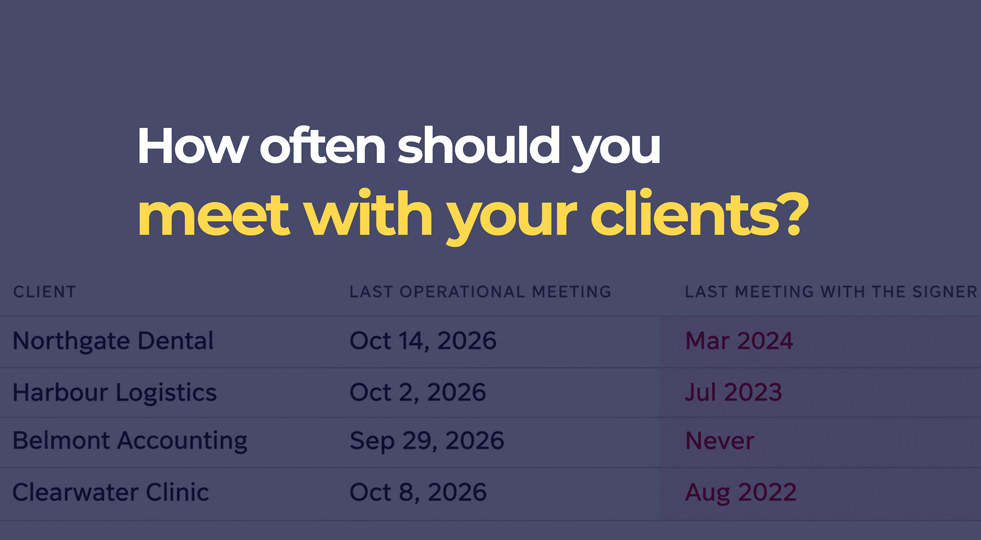
None of it replaces the annual meeting with the decider. You can be in a client’s office every Tuesday and still have an owner who has not heard from you since 2024.
Go look at your list
Write two dates next to every client name. The last operational meeting, and the last time you sat down with the person whose signature is on the agreement.
The first column will look fine…

Simon is the President of S3 Technologies, a leading Canadian MSP he co-founded in 2003. He built and scaled the vCIO team which eventually lead to him co-founding Propel Your MSP in 2018 to help MSPs with their vCIO services.