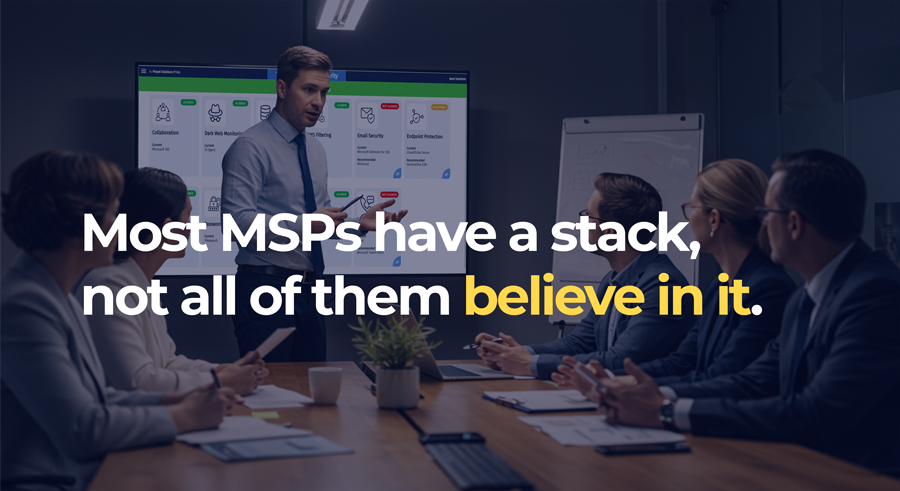
There’s a difference. It shows up in the quality of service you deliver, the speed at which your team solves problems, and in whether you can actually back up what you’re selling.
The mistake most MSPs make
When you bring on a new client, there’s often a moment of hesitation. They’ve got a SonicWall. You support Fortinet. It’s still within its lifecycle, still under warranty, nowhere near end of life. They’ve invested in it. Feels awkward to push a replacement right out of the gate.
I get it. But your client isn’t paying you for the hardware they already have. They’re paying you for an outcome. Reliable infrastructure. Fast response when things break. Security that actually holds up. Peace of mind.
And you can only deliver that outcome with technology your entire team knows well.
Sure, your team can figure out a SonicWall. They’re smart. But will they patch it as fast as they would a Fortinet? Will they catch the security advisory the moment it drops? And more importantly, can they fix a problem with it as fast as they would with a Fortinet they know inside out? Probably not.
When your team knows the stack
Problems get solved faster. Onboarding is smoother. Your engineers stop switching between different firewall vendors and actually develop deep expertise. You can build real, detailed standards. You can specialize.
The best MSPs in the industry are ruthless about this. They have a stack. They believe in it. And they don’t apologize for it.
That conviction matters more than you’d think. When you walk into a client meeting and say “this is what we support, and our entire team is certified” the impression it leaves is very different than “we support whatever you’ve got.”
Where vCIOs come in
Standardization doesn’t always happen at the sale. Sometimes the timing isn’t right, the deal is competitive, or the client pushes back. That’s okay. It doesn’t mean you give up on it.
This is where your vCIOs take over.
During strategic planning, your vCIO should be presenting exactly where each client sits relative to your stack. What’s aligned. What’s not. What risk that creates. And what you’re recommending.
When your vCIO presents this with conviction and explains that to deliver the outcome the client wants, this is what’s needed, most clients will come around. It just takes time and consistency.
We did it at our MSP
At our MSP, we weren’t always great at this. Overtime it was clear: if we wanted to deliver the kind of service we were proud of, we had to standardize. So we made the decision, defined our stack, and used our vCIOs to drive alignment through the IT planning we do with our clients every year.
We didn’t do it overnight. But we converted every single client. Each annual IT planning session was an opportunity to present the misalignment, have the conversation, and move forward. It works, you just have to commit to the process and not shy away from the conversation.
Where to start
The first step is measurement. Map your stack. Define your standards. Then, for each client, figure out where they actually stand. Once you have that picture, start bringing it into your strategic conversations. Be direct. Be confident. Don’t treat it like a sensitive topic.
The conversations might feel uncomfortable the first couple of times. They won’t feel that way for long. Clients appreciate when you’re willing to say “we’re really good at this, and here’s what we need to get you there.”
Propel Your MSP automates this, detecting your stack alignment automatically and giving your vCIO an interactive presentation to walk clients through it. But the tool is secondary. The mindset comes first.
Make it non-negotiable
If you’re carrying clients on technology you don’t specialize in, you are setting yourself up to under-deliver, and your clients will feel it before you do.
Standardize. Believe in your stack. Arm your vCIOs to have the conversation. And do it consistently, year over year, until every client is aligned.
The top MSPs do this. It’s one of the highest-leverage things you can do for your business.

Simon is the President of S3 Technologies, a leading Canadian MSP he co-founded in 2003. He built and scaled the vCIO team which eventually lead to him co-founding Propel Your MSP in 2018 to help MSPs with their vCIO services.